-
Nu.Q® Technology
Our technology detects characteristic epigenetic changes in nucleosomes that occur from the earliest stages of cancer, sepsis and other diseases.
-
- Our Tests
- Human Health
-
Nu.Q® NETs
Nu.Q® NETs is a groundbreaking CE-marked diagnostic solution that clinicians can use to detect NETosis.
-
Nu.Q® Discover
Buy our Nu.Q® Discover H3.1 Research Use Only Assay
- Animal Health
-
Nu.Q® Vet Cancer Test
Nu.Q® Vet Cancer Test is an affordable, accessible blood test that detects cancer in dogs.
-
- Our Pipeline Development
-
Nu.Q® Cancer
We are developing a range of blood-based assays with potential applications beyond cancer detection.
-
Capture-Seq™
We have developed Capture-Seq™, a novel liquid biopsy method designed to isolate and analyze pure circulating tumor-derived DNA (ctDNA) from blood samples.

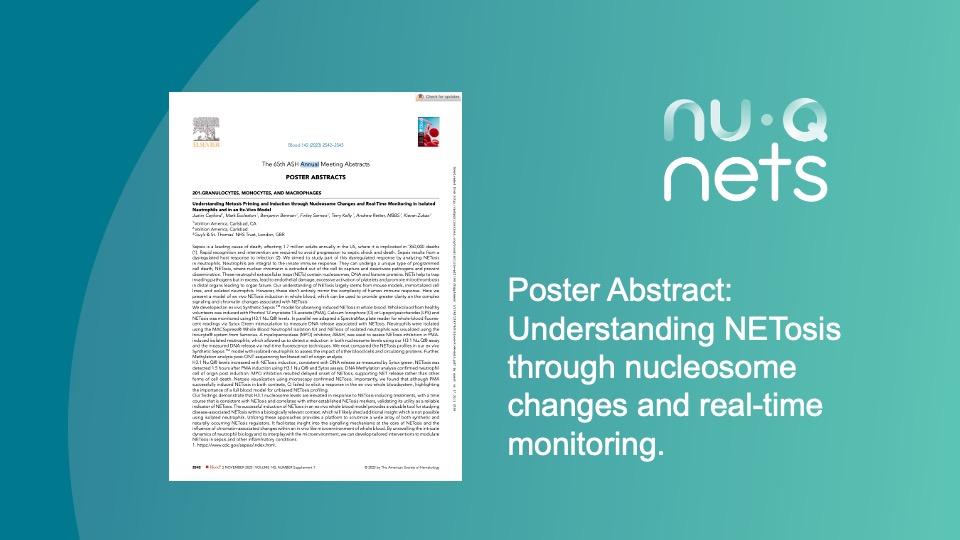
Understanding NETosis through nucleosome changes and real-time monitoring Cayford J.
- Share
- Tweet
- Share on Facebook
- Share
NETosis is an important part of the innate immune response, helping neutrophils capture and neutralize invading pathogens. However, excessive NET formation can contribute to endothelial damage, microthrombosis and organ failure, making it highly relevant to sepsis and other inflammatory conditions.
In this study, researchers developed an ex vivo Synthetic Sepsis™ whole-blood model to investigate NETosis in a more biologically relevant environment than isolated neutrophils alone.
NETosis was induced using PMA, calcium ionophore or lipopolysaccharide, and monitored using the Nu.Q® H3.1 assay, alongside established methods including Sytox Green fluorescence, microscopy and DNA methylation analysis.
Key findings
- Nu.Q® H3.1 nucleosome levels increased following NETosis induction.
- Changes in H3.1 levels were consistent with DNA release measured using Sytox Green.
- NETosis was detected approximately 1.5 hours after PMA induction.
- DNA methylation analysis confirmed that the released material originated from neutrophils.
- Inhibition of myeloperoxidase delayed the onset of NETosis.
- Differences between isolated neutrophils and whole blood highlighted the importance of studying NETosis in a complete blood environment.
The results support the potential use of circulating H3.1 nucleosome levels as an indicator of NETosis. The whole-blood model may also provide a valuable platform for studying NETosis regulators, disease-associated mechanisms and potential interventions in sepsis and other inflammatory conditions.
Read the abstract:
Understanding Netosis Priming and Induction through Nucleosome Changes and Real-Time Monitoring in Isolated Neutrophils and in an Ex-Vivo Model.
DOI: 10.1182/blood-2023-178100
Subscribe for Volition product updates.
Or, click here for Investor Updates and press releases.
"*" indicates required fields